
The Red Baron: Labour militants, women workers, and wildcat strikes in 1960s British Columbia
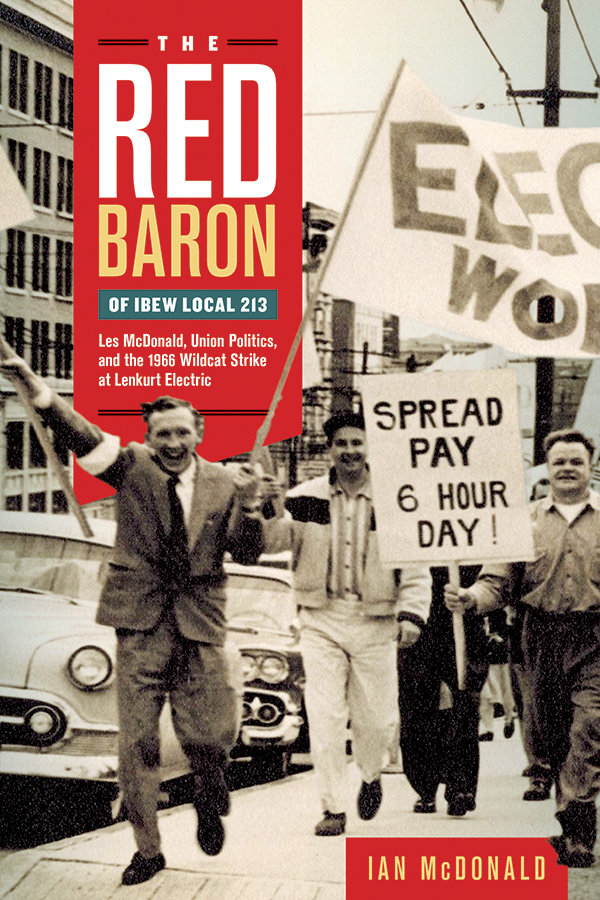
The Red Baron of IBEW Local 213 is a biography of controversial union leader Les McDonald. Through McDonald’s life and activism, the book also offers a glimpse at a variety of issues affecting the working class of British Columbia and beyond from the 1950s through the 1970s. This period was rocked by the impact of the Cold War on internal trade union politics and trade union democracy, the impact of government legislation that at once empowered union leaders and disempowered members, and the influence of emerging working-class feminism on a patriarchal union movement and society, all of which are encapsulated in the wildcat Lenkurt Electric strike, the major focus of The Red Baron. Ian McDonald, son of Les McDonald, paints a broad picture of the conflicts within the BC trade union movement using the background to the strike, the strike itself, and the fallout from the strike’s failure. Remarkably, he manages to do this while only occasionally moving the narrative away from the goings-on in a single local of a single union.
The principal strike issue was compulsory overtime. Lenkurt manufactured telecommunications equipment, and when business was hot the company expected its mainly female workforce to labour overtime. Most of the women had young families, and the demands of both work and domestic care were extremely challenging in a time when women alone were expected to manage their households. Their male-dominated union failed to persuade management to provide consistent, predictable hours of work that exempted women with children from evening shifts. So, the women chose to go on a wildcat strike to win schedules that allowed them to find an equilibrium between their jobs and their home lives.
Wildcat strikes, when they are the product of a majority union vote, are an expression of worker democracy. But, in the economic order that governments constructed after World War II when wholesale denial of the right of workers to organize no longer seemed politically feasible, a key goal of labour legislation was to combat union democracy. Federal and provincial labour legislation limited the scope of issues that unions could negotiate, defining almost all issues other than wages and social benefits as management rights that workers could not bargain away. Union leaders were expected to suppress all efforts of their members to strike other than during a period when there was both no labour contract in force and no order from a labour board to force the workers to stay on the job. That made the union leaders, who were also supposed to represent the interests of their members, into tools of the bosses when the workers believed that management was following policies that were absolutely unacceptable, and decided to strike, no matter by how large a vote. Factions developed within the unions and within leadership. More conservative factions argued that the unions must follow the restrictive labour laws scrupulously, while more radical factions generally argued that unions must defend the interests of their members at all time and be prepared to strike whenever that seemed necessary without regard to whether a strike was legal.
The British Columbia Labour Board was adamant in ruling that no strike could occur for any reason while a collective bargaining contract was in force. An all-male body, it saw nothing significant in the Lenkurt women’s complaint about compulsory overtime. While all leadership factions in the IBEW sympathized with the women who chose to wildcat, more conservative elements in the union argued that the women would have to wait for the next legal round of bargaining. Radicals, led by Les McDonald, an active Communist, blasted that logic, noting that the employer was putting the women and their children in an impossible position. In view of the militancy and near-unanimity of the women workers in the factory, he was as prepared as they were to defy the management and the government to win justice for women workers.
But other leaders in the local and in the central leadership of the union were more concerned with resisting punishing fines that might threaten the union’s continued existence than in the women’s cause. And the Communist Party, which initially gave McDonald some support, soon caved to the union leaders’ logic as well. The union joined with management and the government to break the strike, and the union held to its anti-strike position after the company dismissed many of the strikers rather than let them return to their jobs. As for McDonald, he was suspended from the union for 16 years and, disillusioned with the Communist Party’s failure to support the women, left the party as well. He became a noted sportsman, best known for campaigning successfully to have the triathlon established as an official Olympics sport. His son’s book attempts to be fair to all the factions of the union movement and to emphasize his father’s idealism and his obstinacy as mixed blessings. These qualities sometimes led him to ignore the balance of social forces within society as he committed himself to unwinnable causes.
The Red Baron takes the shine off a period which we think of as the peak period of capitalist willingness to make concessions to workers, particularly unionized workers. McDonald clearly admires his father’s commitment to the Lenkurt workers. Through their cause, he also makes clear how restrictive labour legislation, anti-union enforcement of legislation, contradictory union aims, and patriarchal norms combined in 1966 to shatter women workers’ efforts to win social justice.
While unions have continued to win important improvements for their members, compulsory overtime and unsuccesful efforts to end it via worker resistance remain an ongoing phenomenon. So does the unwillingness of most unions to risk going broke by countenancing wildcat strikes of their rank-and-file to deal with this issue, no matter that such strikes are sometimes unanimously or near-unanimously supported by the members.
By Alvin Finkel
For more on this topic, read “Mandatory overtime is increasingly the norm for Canadian workers” by Steve Hill and Dylan Lubao on World Socialist Website.