
Capitalism and Colonialism: Understanding the machinations that continue to shape our country
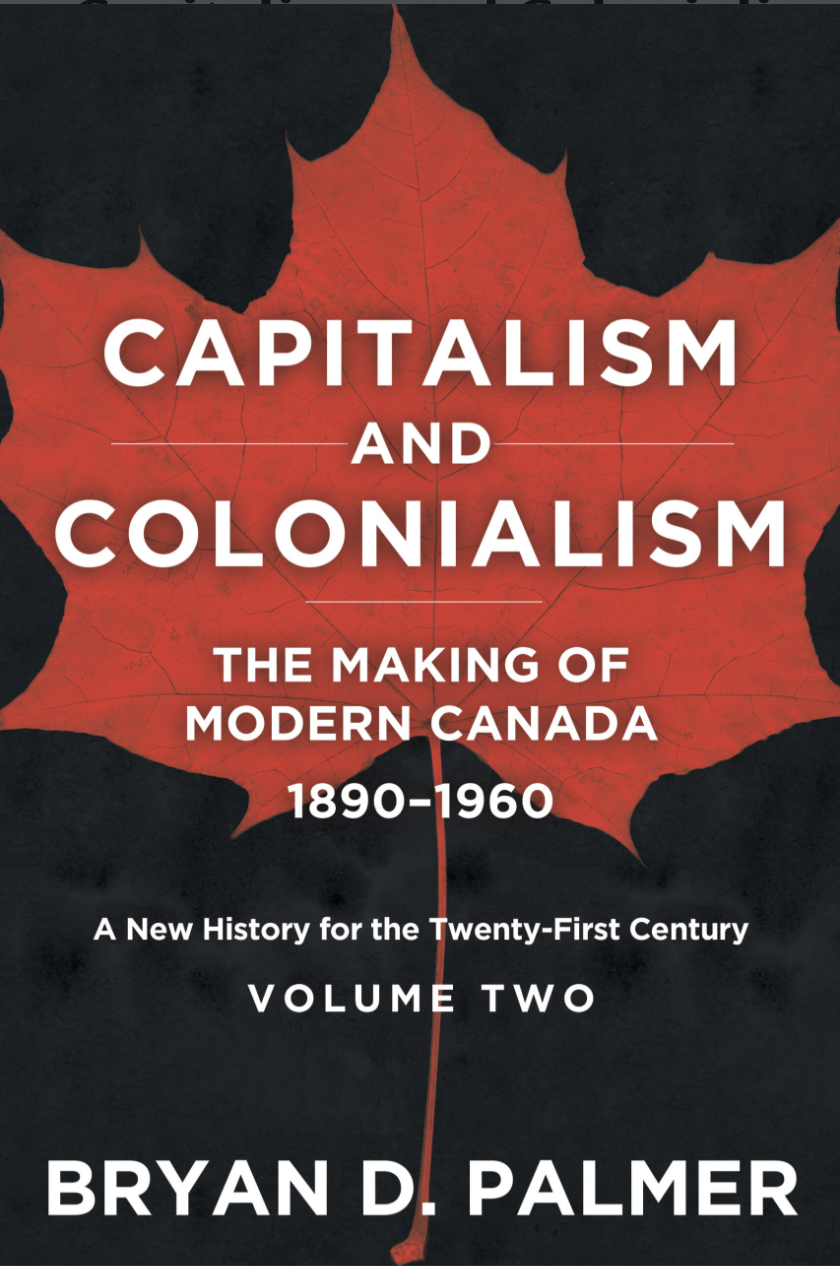
Cover image James Lorimer & Company Ltd.
ALHI members are likely to be among those readers on the lookout for any new title on the history bookshelves. There might also be readers among us more drawn to the latest volume of a science-fiction series, a tale of travel adventures in west Africa, a murder mystery with a wonderful lurid cover, the memoirs of Justin Trudeau, or a new cookbook using only ingredients found naturally in Alberta. Readers fitting any or all of these profiles will find something to enjoy inCapitalism and Colonialism: The making of modern Canada 1890–1960by Bryan D. Palmer.
Capitalism and Colonialism is the second volume of Palmer’s A New History for the Twenty-First Century. It reads easily, moving along with broad contextual paragraphs and enough details and anecdotes to be engaging. But it is equally a volume of serious history, loaded with enough footnotes to let readers move into deeper detail about any bit of the territory it presents broadly. The writing and story will definitely leave readers wanting to go deep with at least a few of the periods and topics it covers.
The first volume in Palmer’s New History set was titledColonialism and Capitalism: Canada’s origins 1500–1890, with a focus on the immense role of colonialism in Canada’s early story. In this second volume, he reverses the titular words to present how capitalism moved into a dominant role in the late 19th century, still ably supported by a continuing deep commitment to colonialism throughout the state and society.
The book offers lots of material about what was happening in the world of ordinary working people, including the ups and downs of organized labour; the machinations of political parties (CCF and Communist); immigration, discrimination, and racism; and the changing dynamics of the industries that drove the economy. Palmer also pays significant attention to Indigenous Peoples and some of the key structures that had an impact on their lives, such as the Indian Act, residential schools, and the reserve system.
As the book moves through the historical narrative, Palmer jumps back and forth, up and down, across Canada, offering a sense of both the flow of the years and of the connections and differences at different times in various parts of the country. Equally, the book describes the complex international entanglements of Canadian capitalism in this period. The insider nature of capitalism is highlighted through the years. For example, Palmer notes that Nova Scotia manufacturer British Empire Steel Corporation, over the decade of the 1920s, had 13 Montrealers, nine Torontonians, three Americans, five UK citizens, and a whole three Nova Scotians on its board. Our present-day neighbourly enganglements are also foreshadowed, as during this time Nova Scotia Premier W.S. Whitney noted, “nature intended… the shipment of large quantities of coal to the United States.”
When I read history, I notice apparent parallels to today. I had this experience many times in the book, such as Maurice Duplessis in 1938 saying, “Under our federal system, each province, within its own jurisdiction, constitutes an autonomous state, enjoying all the prerogatives of a sovereign state without any subjection to the federal power.” Similarly, Palmer noting how, during the Depression years of the 1930s, “Scapegoating the downtrodden became a repetitious refrain, denunciations of the undeserving poor ringing throughout the corridors of power,” and “Time was often on the side of capital and its parliamentary proponents” calls to mind the divisions we are seeing in our current political landscape.
This is a book that gave me both enjoyment and learning, being easy to read, solidly based on research, and leaving me with a reminder of where and how real history is being made. As always, I am reminded of why we need to keep finding how to live the meaning of “They have the money but we have the many” in our own times.
– Jim Gurnett