
ALHI’S 2026 ALHI Calendar Provides Monthly Lessons on a Timely Subject
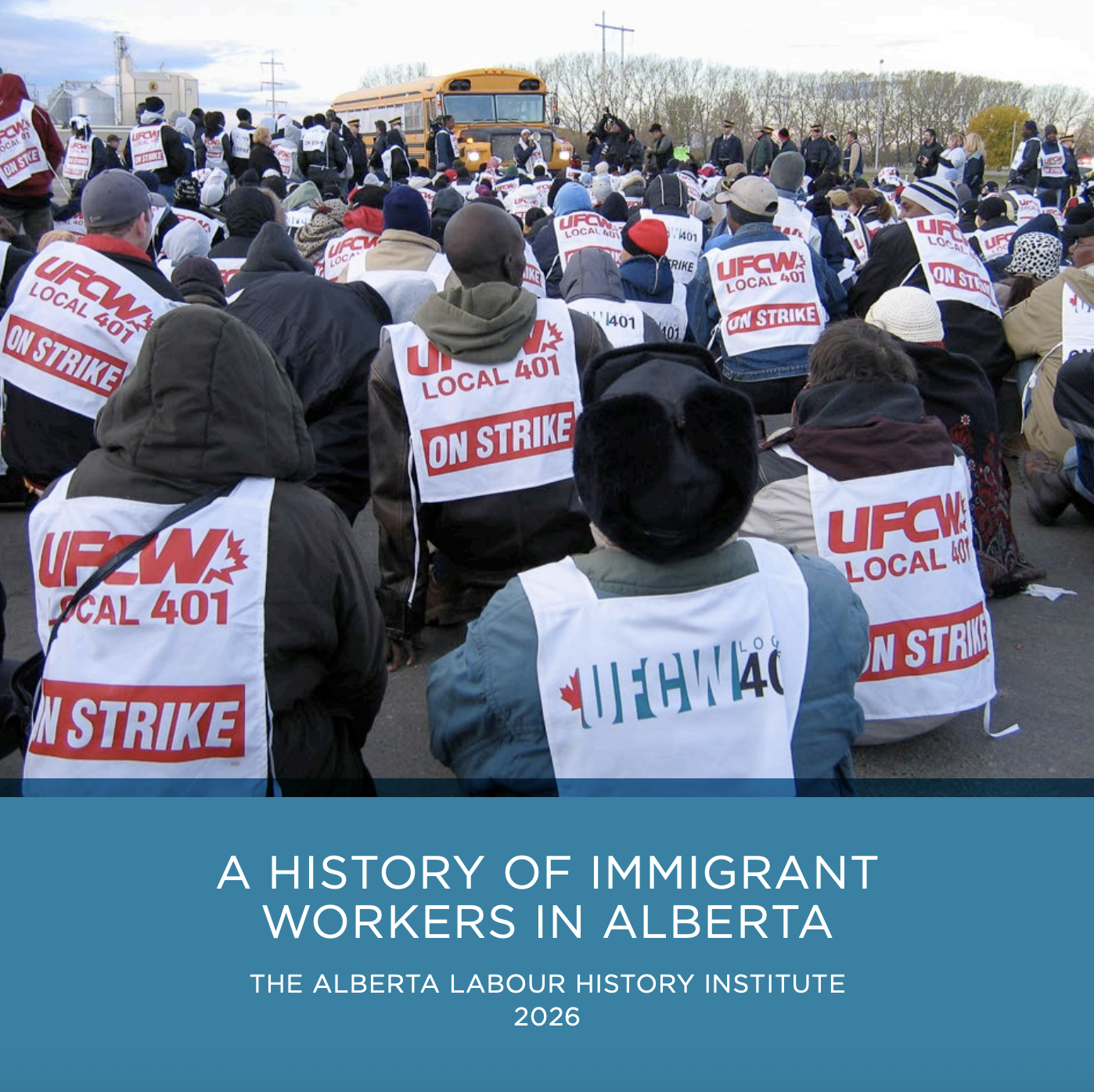
My parents came to Canada in 1913, children of parents leaving Ukraine (Galicia) because of poverty and oppression under Austro-Hungarian administrators and Polish landlords. History books tell us they came to claim ‘free land’, but they were actually part of a massive labour recruitment project to turn the Canadian prairies into a profitable hinterland under a National Policy which served the interests of investors in Central Canada, England and the United States.
Historians call my parents ‘immigrants, but it would be more correct to refer to them as ‘migrant workers,’ a people whose story has been repeated throughout a history in which powerful interests accessed an international labour market to find the workers they needed to do work that no domestic workers were willing to do. Karl Marx’s famous saying, “The workingmen have no country” has often been misinterpreted to mean that workers have no loyalty to their country; in reality, it has always been the rich and powerful who have exhibited little regard for nation or homeland when seeking out the vulnerable labour they needed.
Long before Hebrew slaves were taken to Babylon in the Sixth Century BC, migrant workers were being imported as slaves by warring parties who needed their labour; the way the British Empire turned this into a highly-organized slave trade is well-documented. Employers continued to access the international market long after slavery was officially abolished, searching for desperate populations – who else would voluntarily leave an ancestral home for some of the lowest forms of work and a hard life in a new country? It has been called ‘the face of human misery,’ which could well have referred to the 170,000 ‘First Wave’ Ukrainians who landed on Canada’s shores between 1894 and 1913. The majority came from Eastern Galicia, a province of a distant empire where the Church and Polish gentry owned much of the land and administered the law. Most were peasant farmers who could not support families on postage-stamp plots as small as 2 acres, and whose choice was to either work for the ‘pan’ (lord), or travel to another country to find jobs as ‘guest workers.’
My people, as well as the Italians and other ‘non-preferred’ ethnic groups, were exactly what the labour recruiters had in mind for Western Canada. They were certainly not the first choice, but when the ‘preferred races’ declined Canada’s invitation, Ukrainians were welcomed. So were the families who would form the basic economic unit of production and consumption that was needed if the National plan for the West was to succeed. Not only would women and children be crucial to the day-to-day struggle for survival; family units would also provide for the social reproduction of the labour that employers would require in the future.
The ‘sturdy men in sheepskin coats’ were aggressively recruited. A mostly-secret arrangement in 1899 had the North Atlantic Trading Company (NATC) recruiting and delivering immigrants to Canada through thousands of agents who combed south-eastern Europe marketing the dream of a better life in Canada (along with the advantages of travelling there on steamships owned by the CPR and other companies backing the plan). The most common method of renumeration was a bonus paid to the agent for each immigrant brought into the country. They were paid on a sliding scale that began with $5.00 for each head of family and $2.00 for other family members. Whether or not these recruits would actually make themselves available for farm work was something for which these agents would assume no direct responsibility.
Once in Western Canada, the newcomers would spend their waking hours turning a swath of wilderness, recently cleared of its indigenous inhabitants, into productive farmland dotted with small service centres. Their sweat would not only turn Alberta’s prairies and parkland into a profit-producing region, it would also build the railways, tap the rich mineral and timber resources, build the service and commercial centres, and provide domestic service to make life comfortable for the wealthier, established residents of the Canadian West. While men worked in faraway frontier camps to raise needed capital, women spent long days in unpaid and mostly unrecognised labour developing the homestead and keeping the family alive. Even the children were expected to contribute in the struggle for survival, which meant limited or no schooling for a great many. All would cope with the hazards and extraordinary difficulties of work and life on homesteads and frontier industries.
As if life was not hard enough, the hardships they endured would be salted with shameless discrimination, denigration and racial slurs in the workplace and the host communities. This appeared in newspaper reports about yet another influx of ‘grotesque’ foreigners coming by the hundreds in ox-carts, dressed in strange clothes, speaking a strange language, and living in conditions no self-respecting people would tolerate. It was based in the shameless exploitation reported in frontier work camps, urban manufacturing and homes where Ukrainian girls worked as domestics, and transmuted into exclusion from Alberta’s social mainstream, persistent accusations of criminal behaviour, and finally into mass internment and compulsory registration during World War I.
Through all this, the immigrants worked hard and succeeded in carving out a place in Alberta’s growing agricultural industry, in business and even in political circles. Within in a single generation, many Ukrainian homesteaders who had received almost no public assistance after being ‘dumped’ in the wilderness, and who started farming with grub hoes and wooden ploughshares, were expanding their holdings, buying machinery, and running large herds of purebred livestock. They were going into business, opening hotels, movie theatres and photo studios, and becoming local leaders, at the same time as frontier labourers were emerging as leaders in the workplace, their unions, political parties and civic organizations.
This is the story of my people, the Ukrainian Canadians. It is, however, only one chapter in an ongoing chronicle of migrant labour around the world. In 2003, when the International Convention on the Protection of the Rights of Migrant Workers and Members of their Families was ratified by the General Assembly of the United Nations, its Committee on Migrant Workers estimated that close to 200 million migrant workers and families around the world had left homelands for survival or in a quest for a better life. The numbers have risen dramatically since then. Only a tiny percentage of these will make it to Canada, but even they will only be allowed in when our labour market needs them.
Winston Gereluk
Treasurer
Alberta Labour History Institute